
RNG NEWS
Stay up to date with the latest stories, insights, and announcements.Gov. Brown Signs Bill Extending Requirement for Funding of Clean HD Trucks
On October 10, Governor Brown signed AB1073, which extends the requirement for funding of early deployment of clean heavy-duty trucks as part of California’s Clean Truck, Bus and Off-Road Vehicle program. The bill was sponsored by Eduardo Garcia, whose actions in the legislature have shown his support for growth of the RNG industry.
This bill was supported by the RNG Coalition, but opposed by some staff at the Air Resources Board because it mandates that funds go toward natural gas vehicle deployment. RNG Coalition staff interprets this as a positive signal to our industry from the Administration.
Energy Department Announces $4 Million for Medium/Heavy-Duty, On-Road Natural Gas Engine Research
On October 11, the U.S. Energy Department announced up to $4 million for research projects on medium- and heavy-duty natural gas engine technologies. The Department's Vehicle Technologies Office (VTO) funds early-stage, high-risk research to generate knowledge upon which industry can develop and deploy innovative transportation energy technologies that improve efficiency, lower costs for families and businesses, and increase the use of secure, domestic energy sources.
On October 11, the U.S. Energy Department announced up to $4 million for research projects on medium- and heavy-duty natural gas engine technologies. The Department's Vehicle Technologies Office (VTO) funds early-stage, high-risk research to generate knowledge upon which industry can develop and deploy innovative transportation energy technologies that improve efficiency, lower costs for families and businesses, and increase the use of secure, domestic energy sources.
Opportunities exist to improve performance, reliability, durability, cost effectiveness, and efficiency of natural gas vehicles through research. Cost-effectively achieving diesel-like efficiency in natural gas engines while meeting current and future emissions standards will improve the viability of natural gas-fueled medium- and heavy-duty vehicles.
A public workshop on natural gas vehicles was held at the National Renewable Energy Laboratory on July 25, 2017 to identify early-stage research needs for natural gas engines. A summary of the key observations can be found here. VTO is seeking projects to address barriers to the adoption of natural gas vehicles through early-stage research. Projects competitively selected through this funding opportunity will complement additional early-stage research on medium- and heavy-duty natural gas engine technologies at DOE national laboratories.
For more information and application requirements, please visit the EERE Exchange website or Grants.gov.
DOE's Office of Energy Efficiency and Renewable Energy supports early-stage research of energy efficiency and renewable energy technologies that enhance energy affordability, reliability, and resilience and strengthen U.S. energy security, economic growth, and environmental quality. To learn more about VTO's work with industry, academia, and national laboratory partners on transportation technologies, please visit energy.gov/vehicles.
California Council on Science & Technology to Reassess Pipeline Access Requirements for RNG in California
On Friday, September 29, the California Public Utilities Commission (CPUC) signed a contract with the California Council on Science & Technology (CCST) to conduct a reevaluation of pipeline access requirements for renewable gas in California.
On Friday, September 29, the California Public Utilities Commission (CPUC) signed a contract with the California Council on Science & Technology (CCST) to conduct a reevaluation of pipeline access requirements for renewable gas in California.
Pursuant to SB 840 (2016), the CCST has nine months to perform a study focused on reassessing the current pipeline access requirements for biomethane in California, especially as it pertains to requirements for minimum heating value and siloxanes. Stanford University is a collaborating partner, and will be performing the research for CCST.
RNG Coalition staff is hopeful that Stanford will be able to complete and submit their findings to the CCST by the end of 2017. By law, once the study is completed and delivered to the CPUC, the CPUC has six (6) months to act on it.
Gov. Brown Signs Food Recovery Bill Seen as Model for Other States
By Cole Rosengren, Waste Dive.
California Gov. Jerry Brown signed AB 1219, the California Good Samaritan Food Donation Act, into law on Oct. 9. The act expands existing state liability protections to cover donations made directly to end users, whereas the previous law only covered donations made to food banks or non-profit groups. AB 1219 was co-sponsored by Californians Against Waste and the California Association of Food Banks.
Another key change made by AB 1219 is that donations of perishable or nonperishable food will now be protected if deemed "fit for human consumption," regardless of whether those items have exceeded their recommended date labels.
Californians Against Waste also sponsored AB 954, which is still awaiting Brown's signature. That bill would direct the California Department of Food & Agriculture, in coordination with the Department of Public Health, to publish information about date label standards by July 2018. Manufacturers, processors and retailers would be asked to voluntarily begin using "BEST if Used by” or “BEST if Used or Frozen by” to indicate quality dates, and “USE by” or “USE by or Freeze by” to indicate safety dates.
States take initiative on energy policy while gridlock remains in Washington
By Energize Weekly.
Energy policy, legislation and initiatives are alive and bipartisan in the state houses across the country even as they are bogged down in the nation’s capital, according to the Center for the New Energy Economy at Colorado State University.
More than 12,500 energy bills were introduced in state legislatures between 2013 and 2016, with 1,926 passing, according to the center’s Advanced Energy Legislation Tracker. In 2017, 3,046 bills have already been introduced with 350 passing.
“If you look at the combination of what is happening in blue and red and purple states, there is far more happening than is happening at the federal level,” Bill Ritter, the center’s director and former governor of Colorado, told Energize Weekly in a wide-ranging interview.
“We track every piece of legislation introduced at the state level until it dies or becomes law,” Ritter said. “What is so interesting, so different from what is happening in the United States Congress and the Trump administration is that there is a real bipartisan flavor to what is happening at the state level.”
New SWANA President Jeff Murray takes over for FY18
By Cole Rosengren, Waste Dive.
The Solid Waste Association of North America (SWANA) formally announced that Jeff Murray has taken over as president of the organization for FY18. Murray was elected at the ISWA World Congress & WASTECON in Baltimore on Sept. 26.
By Cole Rosengren, Waste Dive.
The Solid Waste Association of North America (SWANA) formally announced that Jeff Murray has taken over as president of the organization for FY18. Murray was elected at the ISWA World Congress & WASTECON in Baltimore on Sept. 26.
Murray is an associate and the solid waste section manager for HDR in Raleigh, NC. He is a registered professional engineer in North Carolina, Delaware and Virginia, and is certified by the American Academy of Environmental Engineers. He also received that organization's Grand Prize Award for the development of a "Landfill Based Geothermal Heating System" in 2013.
In addition to Murray, SWANA's other officers now include Rich Allen as past president, Frank Caponi as vice president, Michael Greenberg as treasurer, and Brenda Haney as secretary.
Poll: San Pedro Bay Residents Support an Accelerated Clean Air Action Plan, Favor Taking Action Now
By Samantha Mehlinger, Assistant Editor, Long Beach Business Journal.
In a poll of 400 “likely voters” in Long Beach, San Pedro and Wilmington, more than 70% reported that they were supportive of the San Pedro Bay Ports Clean Air Action Plan draft update. The policy document lays out proposed regulations and goals for converting trucks and equipment to near-zero and zero emission technology.
Funded by the California Natural Gas Vehicle Coalition, the phone poll was conducted from August 15 to 17 by Los Angeles-based research firm Fairbank, Maslin, Maullin, Metz & Associates (FM3). Those polled were selected at random, and the margin of error is 4.9% in either direction, according to the survey results.
The draft Clean Air Action Plan (CAAP) would require that all trucks entering the ports meet a near-zero emission standard by 2023 and a zero-emission standard by 2035 or face a fee. It also would require cargo handling equipment to operate at zero emissions by 2030. The Long Beach and Los Angeles harbor commissions are scheduled to vote on a final version of the document on November 2.
A 90% majority of those surveyed supported the overall zero-emissions goal of 2035. Only 6% opposed the proposal, with 4% unsure.
An 84% majority supported creating guidelines beyond what state and federal regulations require.
US DOE's Argonne National Lab updates biofuel & RNG feedstocks in new AFLEET Tool version
A newly updated version of the AFLEET Tool from the U.S. Department of Energy’s (DOE) Argonne National Laboratory is now available. AFLEET — short for Alternative Fuel Life-Cycle Environmental and Economic Transportation Tool.
The AFLEET Tool is ideally suited to aid those who make purchasing decisions for fleets as they compare vehicle technologies for emission reductions and air quality gains. This new version adds the ability to look at air pollutant emissions from well-to-wheel as it lets users evaluate not just “at-the-tailpipe” air pollutants, but also those arising from fuel production.
On October 10, the U.S. Department of Energy announced that Argonne National Labs has completed its GREET 2017 model and associated updates to the Alternative Fuel Life-Cycle Environmental and Economic Transportation (AFLEET) Tool.
This new version adds the ability to look at air pollutant emissions from well-to-wheel as it lets users evaluate not just “at-the-tailpipe” air pollutants, but also those arising from fuel production.
New AFLEET Tool Features include:
- Idle Reduction Calculator
- Low-NOx engine option for CNG and LNG heavy-duty vehicles
- Diesel in-use emissions multiplier sensitivity case
- Well-to-pump air pollutants
- Vehicle cycle petroleum use, GHGs, and air pollutants
- Renewable diesel vehicles
- Electric commercial trucks
- Updated biofuel and RNG feedstocks
View the AFLEET Tool updates and download the latest version HERE.
Read more on the GREET model updates HERE, and download the new GREET model HERE.
Proposed Clean Fuel Standard: Canada's 'single biggest carbon-fighting policy' you've probably never heard of
Canada's proposed clean fuel standard could actually have more of an impact on carbon emissions than a carbon price will
By Maura Forrest, National Post.
Canada’s environment commissioner Julie Gelfand delivered a stern warning to the federal government this week, declaring that to deal with climate change Ottawa needs to move “from a seemingly endless planning mode into an action mode.”
That will mean more than just putting a price on carbon — to date the only element in the Liberals’ pan-Canadian climate change framework that’s received much attention. The government’s plan also includes a suite of lesser-known policies, including a proposed clean fuel standard that some say amounts to a second carbon tax.
The new standard, likely unknown to most Canadians, could actually have more of an impact than a carbon price in cutting Canada’s carbon emissions to 30 per cent below 2005 levels by 2030, according to some experts.
Renewable Natural Gas Increasingly Used to Meet Part of EPA’s Renewable Fuel Requirements
By Steve Hanson, U.S. Energy Information Administration.
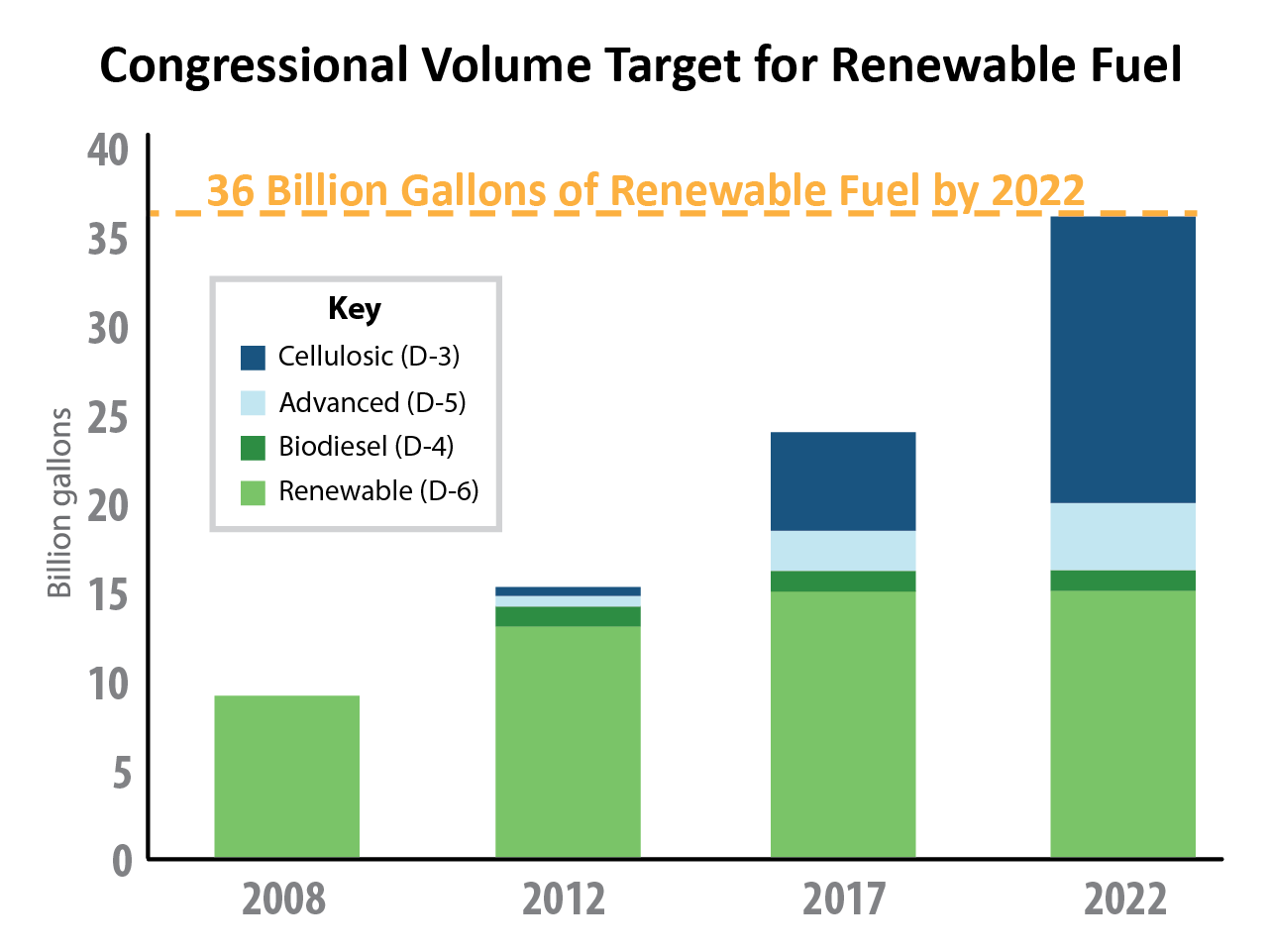
Renewable natural gas (RNG), which is derived from biogas collected at landfills and other facilities, is increasingly used to meet government targets for renewable fuel production. In 2016, about 189 million gallons of RNG were used to meet about 82% of federal targets set specifically for cellulosic biofuel.
By Steve Hanson, U.S. Energy Information Administration.

Renewable natural gas (RNG), which is derived from biogas collected at landfills and other facilities, is increasingly used to meet government targets for renewable fuel production. In 2016, about 189 million gallons of RNG were used to meet about 82% of federal targets set specifically for cellulosic biofuel.
The Renewable Fuel Standard (RFS) is a program implemented by the U.S. Environmental Protection Agency(EPA) to promote the incorporation of biofuels in the nation’s fuel supply. Earlier this year, EPA released a proposed rule to determine 2018 renewable volume obligations, and total volumes will remain largely unchanged from 2017 levels. Volume obligations for two categories—advanced biofuel and cellulosic biofuel—were slightly reduced from 2017 levels.
In previous years, when targets for those categories were not met, EPA has exercised its cellulosic biofuel waiver authority to account for shortfalls. In 2016, for instance, only 189 million gallons of cellulosic fuel were produced, less than EPA’s renewable fuel volume requirement of 230 million gallons and far below the original congressional volume target of 4.25 billion gallons for that year.
Don’t miss an update—join our weekly newsletter below.