

RNG NEWS
Stay up to date with the latest stories, insights, and announcements.Nova Scotia reaches agreement on cap-and-trade program, aiming to reduce emissions by 30%
By Peter Maloney, Utility Dive.
Utility Brief:
Canada has reached an agreement with the province of Nova Scotia that calls for the establishment of a cap-and-trade program for carbon dioxide emissions from power plants.
Nova Scotia is also working with the central government to draw up an equivalency agreement for the accelerated phase-out of coal-fired generation in the province.
- The agreement also calls for the adoption of a provincial target that meets or exceeds Canada’s target of reducing emissions by 30% from 2005 levels by 2030.
By Peter Maloney, Utility Dive.
Dive Brief:
Canada has reached an agreement with the province of Nova Scotia that calls for the establishment of a cap-and-trade program for carbon dioxide emissions from power plants.
Nova Scotia is also working with the central government to draw up an equivalency agreement for the accelerated phase-out of coal-fired generation in the province.
- The agreement also calls for the adoption of a provincial target that meets or exceeds Canada’s target of reducing emissions by 30% from 2005 levels by 2030.
Dive Insight:
Nova Scotia’s plans to curb power plants emissions align its energy strategy with the just announced plan by the central government to phase out traditional coal plants by 2030.
Under that plan, traditional coal-fired plants are required to meet a performance standard of 420 tonnes of carbon dioxide (tCO2)/GWh within the next 14 years.
That standard allows for coal plants to continue operation if they are equipped with carbon capture and sequestrations (CCS) technology.
Buckle Up for a Wild Ride: Trump and the Environment
By Bernadette M. Rappold, The Legal Intelligencer.
Millions of Americans are coming to grips with the broad social and political ramifications of Donald Trump's stunning upset victory in last Tuesday's presidential election. And while the president-elect's policy pronouncements to date have been short on detail, one thing is clear: those concerned with environmental protection and climate change had better buckle up for a wild ride.
As a 15-year veteran of the U.S. Environmental Protection Agency (EPA) and former agency enforcement official, I served under both Republican and Democratic administrations and played key roles in briefing incoming political leadership during transitions. As I know up close, for better or worse, federal agencies are not nimble and do not steer on a dime, a fact that often frustrates new political leadership.
While the rhetoric of campaigns does not always translate into the actions of governance, Trump's environmental policy appears to rest on the twin pillars of deregulation and fossil fuel promotion. While Trump's economic focus during the campaign was on trade deals and lower taxes, he also believes that over- regulation, particularly by the EPA and Department of Interior, is responsible for the loss of good-paying manufacturing jobs in the United States. He has pledged to place a temporary moratorium on new rulemaking early in his administration and has stated two regulations will be withdrawn for every new regulation promulgated during his term.
By Bernadette M. Rappold, The Legal Intelligencer.
Millions of Americans are coming to grips with the broad social and political ramifications of Donald Trump's stunning upset victory in last Tuesday's presidential election. And while the president-elect's policy pronouncements to date have been short on detail, one thing is clear: those concerned with environmental protection and climate change had better buckle up for a wild ride.
As a 15-year veteran of the U.S. Environmental Protection Agency (EPA) and former agency enforcement official, I served under both Republican and Democratic administrations and played key roles in briefing incoming political leadership during transitions. As I know up close, for better or worse, federal agencies are not nimble and do not steer on a dime, a fact that often frustrates new political leadership.
While the rhetoric of campaigns does not always translate into the actions of governance, Trump's environmental policy appears to rest on the twin pillars of deregulation and fossil fuel promotion. While Trump's economic focus during the campaign was on trade deals and lower taxes, he also believes that over- regulation, particularly by the EPA and Department of Interior, is responsible for the loss of good-paying manufacturing jobs in the United States. He has pledged to place a temporary moratorium on new rulemaking early in his administration and has stated two regulations will be withdrawn for every new regulation promulgated during his term.
Trump has stated his intention to counter the "war on coal," which, he claims, has shuttered mines, cost jobs and left valuable natural resources in the ground. He plans to lift the Department of Interior's moratorium on coal leasing and has pledged to open additional federal lands and waters to energy extraction.
The president-elect once called for the EPA's eradication, but has more recently suggested that while vast portions of the agency should be cut and its ranks reduced, some small pockets should remain. (He plans to impose a federal governmentwide hiring freeze to reduce employee ranks through attrition, "exempting military, public safety and public health.") Trump does not believe in anthropogenic climate change, often calling it a Chinese hoax.
Trump has pledged to "cancel" the 2015 Paris climate accord. Since the climate accord is not a treaty ratified by the Senate, the president-elect can withdraw from it via executive action. But Trump's pledges on regulation, however, are not so readily fulfilled.
He has repeatedly promised to withdraw President Barack Obama's Clean Power Plan, which would impose limits on greenhouse gas emissions from power plants. Further, he has promised to pull another key rule, the EPA and Army Corps of Engineers' Waters of the U.S. rule (WOTUS), which was designed to eliminate uncertainty in the wake of several confusing and contradictory U.S. Supreme Court decisions and which, like the Clean Power Plan, is currently being challenged in federal court.
Both the Clean Power Plan and WOTUS are final agency regulations, and the president-elect cannot simply undo them with the stroke of a pen. He can, however, elect not to defend the regulations in the pending litigation or ask the courts to vacate the rules pending further agency action. Or he can undertake a new notice- and-comment rulemaking to withdraw the rules—rules which would themselves be subject to litigation. The Trump administration is likely not to enter "friendly settlements" with the plaintiffs who bring this almost certain litigation.
The net effect? Federal regulation of greenhouse gases from power plants will likely be significantly delayed, and the United States looks destined to default on its international promise to submit "nationally determined contributions" by 2018 under the Paris accord. With the United States as the world's second largest emitter of greenhouse gases, developing economies may balk at their commitments and the Paris accord itself could unravel.
Trump has said little about the rest of the EPA's programs and functions. But since 2010 the agency has lost about 28 percent of its budget and 13 percent of its staff, and there is reason to expect that downward trend to continue. And while certain senior political leaders at the agency have advocated strenuously for improvements to the EPA IT infrastructure and other technology investments that would enable agency staff to do more with less, those improvements look likely to remain on hold indefinitely.
Still, while President-elect Trump will enjoy Republican majorities in the House and Senate, he appears unlikely to rally the votes necessary for wholesale repeal of the fundamental environmental statutes that the EPA administers. This should trouble industry, even industries that believe the agency has been overzealous, because most statutes contain provisions allowing citizens to sue the EPA for failing to take nondiscretionary actions and industry for violating the law.
While citizen suits play a role in holding the EPA accountable, they are poor and protracted substitutes for regulation. Just ask the scores of companies who have been on the receiving end of citizen suits; whenever possible, most prefer a consensual arrangement with the EPA or a state regulator over a court-imposed injunction.
As Trump assembles his transition team and begins to fill the EPA's political ranks, one might expect industry to impress on him the necessity to refrain from gutting the agency. After all, huge sections of our economy depend on the agency's decision-making, and some, like the renewable fuels industry, would not exist outside California without the EPA.
Perhaps ironically, enforcement and compliance monitoring at the EPA may be the area that undergoes the fewest changes in a Trump administration. The president-elect has repeatedly emphasized "law and order" as a grounding principle, and enforcement of existing laws and regulations (except for the Clean Power Plan and WOTUS) would seem in keeping with that principle.
There is historical precedent for this view. President George W. Bush sought repeatedly to change fundamental environmental laws and regulations; prime examples included "Range Readiness Preservation Initiative" to exempt military facilities from virtually all environmental and habitat preservation laws and his "Clear Skies Initiative" to create a cap-and-trade program to reduce NOx, SOx and mercury, but left carbon pollution untouched.
While Range Readiness and Clear Skies never gained traction in a divided Congress, President Bush generally did not meddle with EPA enforcement (except for power plant litigation, which remained squarely in the administration's sights), driving many decisions down to the career, rather than, political level. While few EPA enforcement staffers would publicly admit it, many privately concede that while they disagreed with the Bush administration's legislative and regulatory agenda, they liked that administration's generally hands-off approach to enforcement.
Much will depend, of course, on whom Trump selects to become the EPA administrator. In addition to the Competitive Enterprise Institute's Myron Ebell who is heading up the Trump environmental transition team, rumored potential administrators include Robert E. Grady, an investment banker who helped to draft the Clean Air Act Amendments of 1990, and Jeffrey R. Holmstead, a lawyer at Bracewell LLP and the former deputy administrator under the last Bush administration. Of the three, Holmstead appears the most moderate and seems to embody what one pundit called "the practical environmentalism" the president-elect espouses.
The transition at the EPA has already begun, with staff across the agency fanning out to prepare non-confidential briefing books for the newcomers; confidential briefings will await the new team's official on-boarding. Morale, already at low ebb after years of budget cuts, seems to have sunk to a new low, with many staff worried whether they will keep their jobs.
While Trump's environmental changes at the federal level will likely be significant, states retain their environmental prerogatives and authorities. So regardless of what happens to WOTUS, for example, Pennsylvania will continue to define all water, including groundwater, as a "water of the commonwealth," so there is no issue that wetlands are regulated under Chapters 102 and 105 of Title 25 of the Pennsylvania Code.
Still, at the federal level, change is coming. Exactly how much and how fast remain to be seen.
REW 2016 Conference: Adapting to a new reality
By Kristin Smith, Renewable Energy from Waste Magazine.
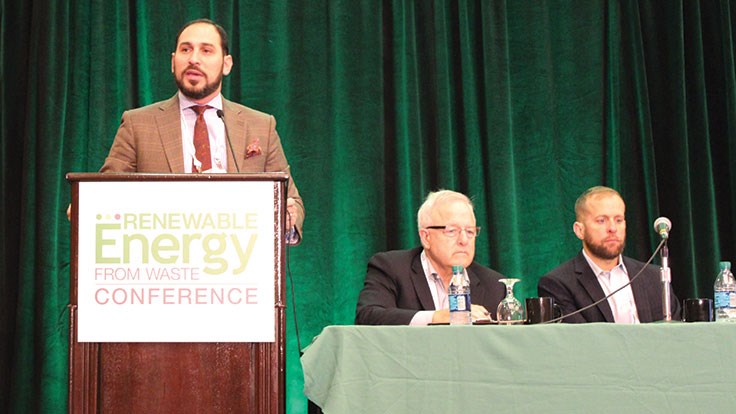
Johannes Escudero, Coalition for Renewable Natural Gas Inc., provides an update on the renewable natural gas market during the 2016 REW Conference. Seated are Harvey Gershman, Gershman, Brickner & Bratton, left, and Ted Michaels, Energy Recovery Council.
With the election having concluded a week prior, the 2016 Renewable Energy from Waste (REW) Conference held in mid-November in Long Beach, California, had attendees discussing the implications of the results.
During the opening session titled “Waste Conversion Market Updates,” several speakers shared their views on the market for waste conversion, including biogas, at the local, and national levels.
By Kristin Smith, Renewable Energy from Waste Magazine.
Johannes Escudero, Coalition for Renewable Natural Gas Inc., provides an update on the renewable natural gas market during the 2016 REW Conference. Seated are Harvey Gershman, Gershman, Brickner & Bratton, left, and Ted Michaels, Energy Recovery Council.
With the election having concluded a week prior, the 2016 Renewable Energy from Waste (REW) Conference held in mid-November in Long Beach, California, had attendees discussing the implications of the results.
During the opening session titled “Waste Conversion Market Updates,” several speakers shared their views on the market for waste conversion, including biogas, at the local, and national levels.
Moderator and speaker Harvey Gershman, president, Gershman, Brickner & Bratton (GBB), Fairfax Virginia, emphasized the importance of keeping waste local to create a circular economy.
“You build a green gate so you don’t have to jump over a green fence,” he told attendees.
He noted that 9,000 curbside recycling programs are operating in the U.S. and 347 million tons of municipal solid waste are managed in the U.S.
Collecting waste is 40 percent of the cost of managing it and it is important for communities to try to “squeeze that inefficiency out.”
A lot of organics are left in the waste stream after recycling. To process these organics, several anaerobic digestion facilities are in the planning and construction phases.
He also mentioned that a Hartford, Maryland waste-to-energy facility closed down while a new facility in West Palm Beach, Florida began operating. “Did you hear about the problems?” he joked. “No there were none. It works,” he said of the new facility.
Ted Michaels, president of the Energy Recovery Council (ERC) and partner, AJW Inc., Arlington, Virginia, gave some insights and predictions on how the election results will impact the waste to energy sector.
“This was going to be a historic election either way,” he said. “We were either going to get the first female president or the first president with no government or military experience, and we got the latter.”
He said it was a result that the experts didn’t see coming. “What can’t happen happened,” he said. “We don’t know what is possible.”
The unpredictable results of Donald Trump winning the presidential election, he says shows that the country is deeply divided and very polarized.
He noted that the first thing the President Elect is beginning to do is put his administration in place.
The first big choice was picking RNC Chairman Reince Priebus, as White House chief of staff.
A potential pick for U.S. Environmental Protection Agency (EPA) director which has since the presentation been confirmed was Myron Ebell. Michaels noted that he was a climate change skeptic and with him at the helm, the agency would scale back. The EPA’s Landfill Methane Outreach Program (LMOP) and other efforts to combat greenhouse gas emmisions “are going to be threatened,” said Michaels.
A top candidate for the Department of Energy was Harold G. Hamm, whom Michaels said is chief executive of continental resources, an oil and gas company, and a top candidate for the Department of the Interior is Forrest Lucas, president of Lucas Oil Products, which manufactures automotive lubricants, additives and greases.
In states with gubernatorial elections, 5 Democrats and 6 Republicans were elected, making a total of 33 states with Republican governors and 15 with Democratic governors. State houses were significantly Republican and while he said in the senate, people thought senate would flip, but it stayed republican.
For the first time ever, Michaels said, “Every state who elected a senator went for the same party in Presidential election.” The House of Representatives stayed roughly the same, he added with 194 Democrats to 241 Republicans.
Key committee leadership affecting waste conversion policies, include the Senate Energy and Natural Resources Committee, Senate Environment and Public Works Committee, and the House Energy and Commerce Committee.
He noted that one of the Democrat ranking members of the Senate Environment and Public Works Committee, Thomas Carper signed the signed moratorium on new waste-to-energy facilities in Delaware.
ARB Research Seminar: The Feasibility of Renewable Natural Gas as a Large-Scale, Low Carbon Substitute
California Air Resources Board will host a research seminar to present and discuss the findings of a Renewable Natural Gas Feasibility study on Friday, December 2, 2016 at 10:00 am, to be conducted by Amy Myers Jaffe, M.S., University of California, Davis and Nathan Parker, Ph.D., Arizona State University.
California will need high volumes of alternative low carbon fuels to be able to meet its climate change goals. In order to support these goals, this study investigated the technological and commercial feasibility of producing large quantities of renewable natural gas fuels for use in California.
California Air Resources Board will host a research seminar to present and discuss the findings of a Renewable Natural Gas Feasibility study on Friday, December 2, 2016 at 10:00 am, to be conducted by Amy Myers Jaffe, M.S., University of California, Davis and Nathan Parker, Ph.D., Arizona State University.
California will need high volumes of alternative low carbon fuels to be able to meet its climate change goals. In order to support these goals, this study investigated the technological and
commercial feasibility of producing large quantities of renewable natural gas fuels for use in California.
The study’s results indicate that there are substantial sources of RNG in California that are commercially competitive with existing fossil fuel-based transportation fuels because carbon externalities are taken into consideration in the California market through existing programs
such as the Low Carbon Fuel Standard (LCFS) and the U.S. Renewable Fuels Standard (RFS).
At current credit prices including California’s LCFS and the U.S. federal Renewable Identification Number (RIN) credits, up to 82 billion cubic feet per year (bcf/y) of RNG supply could be attractive for private investment at competitive rate of return in developing RNG sources from landfill, dairy, municipal solid waste and waste-water sites combined. We find that the LCFS credit of $120 per metric tonne of CO2, if taken alone, enables economically viable production of up to 14 bcf RNG transportation fuel over the study period, which begins in 2013 and extends into the
2020s, 6.3 bcf from landfill, 1.5 bcf from waste-water treatment, 1.75 bcf from municipal solid waste, and 4.3 bcf from dairy.
If current carbon credit prices persist into the future for programs like the LCFS, a substantial portion of natural gas consumption in the transportation sector can be satisfied by RNG. The analysis also shows that increasing tipping fees for municipal solid waste can influence private investment in RNG. Finally, the study investigates the impact of California’s quality standards for RNG and distance to central distribution systems on the level of investment in certain kinds of RNG.
These results support the implementation of the Low Carbon Fuel Standard, Short-lived Climate Pollutant Strategy, and incentive programs by providing insight into feasible methods to maximize the production of RNG via the most cost-effective pathways, thereby providing practical means to meet the State’s long term climate goals.
Details for the seminar are as follows:
Friday, December 2, 2016 10:00 a.m., PST (WEBCAST)
Sierra Hearing Room, 2nd Floor, Cal/EPA Building
1001 I Street, Sacramento, California
For more information, including the webcast link and presentations, visit the announcement webpage at https://www.arb.ca.gov/research/seminars/jaffe/jaffe.htm.

Gas sales become easier for landfill operators
Republic Services Landfill at 7001 S. Bryant Ave. in Oklahoma City was the first landfill in the state to capture its methane gas for commercial use. (Photo by Brent Fuchs)
By Sara Terry-Cobo, The Journal Record.
OKLAHOMA CITY – Business opportunities are opening up to Oklahoma landfill owners, thanks to changes in federal laws. National clean air incentives are improving the economics for projects that turn waste into fuel. That could turn into cheaper compressed natural gas for municipal fleet owners.
Adriane Jaynes said she’s trying to connect those city fleet managers to the landfill operators. She coordinates the Tulsa Clean Cities program, a local chapter of a national coalition to cut air pollution in government fleets. Landfill gas conversion projects will help her members, many of whom already have compressed natural gas, or CNG-fueled vehicles as part of their city fleets.
Republic Services Landfill at 7001 S. Bryant Ave. in Oklahoma City was the first landfill in the state to capture its methane gas for commercial use. (Photo by Brent Fuchs)
By Sara Terry-Cobo, The Journal Record.
OKLAHOMA CITY – Business opportunities are opening up to Oklahoma landfill owners, thanks to changes in federal laws. National clean air incentives are improving the economics for projects that turn waste into fuel. That could turn into cheaper compressed natural gas for municipal fleet owners.
Adriane Jaynes said she’s trying to connect those city fleet managers to the landfill operators. She coordinates the Tulsa Clean Cities program, a local chapter of a national coalition to cut air pollution in government fleets. Landfill gas conversion projects will help her members, many of whom already have compressed natural gas, or CNG-fueled vehicles as part of their city fleets.
Those landfill-gas-to-CNG projects are particularly attractive to Clean Cities members who have their own natural gas fueling stations on municipal property, she said.
Decomposing garbage in landfills creates methane, but the smog-forming gas can’t just be released into the air, said Oklahoma Department of Environmental Quality’s Fenton Rood. Landfill operators can burn that gas, or capture it and use it. The methane rotting garbage produces can be processed to have the same properties as the natural gas that resides in underground rock formations.
David Cox travels the country explaining those landfill-to-CNG opportunities to fleet owners. The general counsel for a nonprofit trade association, the Coalition for Renewable Natural Gas, said the processing equipment has been around for years. But a 2014 change in the national Clean Air Act allowed landfill gas to qualify for renewable fuel incentives. The change helps those projects become economical and competitive against geologic natural gas, he said.
An Ardmore landfill operator is examining several possible purchasers for a renewable natural gas project, said Rood, the DEQ’s land protection division assistant director. One buyer would use the gas for a CNG fleet, one would process the gas to put it into a pipeline, he said.
The first landfill in Oklahoma to capture and reuse its methane gas was a Republic Services-owned facility near the Plaza Mayor at the Crossroads, near Interstate 240. The buyer was General Motors. But that changed when the auto plant closed, Rood said.
“They are still selling some to a plastics manufacturer, but in the absence of (GM’s) demand, they have to flare some,” he said.
Cox said he expects more landfill-gas-to-CNG projects will emerge soon, in part because of the demand for CNG in vehicles.
Renewable energy is seeping into small-town America
By David Roberts, Vox.
Climate change is a highly polarized and contentious issue. It has taken on great symbolic significance for both sides of America’s deep partisan divide. And if Donald Trump and the GOP actually follow through on what they’ve promised, federal climate policy may all but disappear.
Clean energy, however, is different. In public opinion polls, it is supported by virtually every demographic, region, and party.
What’s more, unlike the abstractions involved in climate, clean energy is real, tangible, and — perhaps most important of all — commercially viable. There are many things that divide Americans, but they are generally united on the benefits of making money.
Obama Administration Issues Rules on Methane From Oil, Gas Operations
By Amy Harder, The Wall Street Journal.
WASHINGTON—The Interior Department issued regulations Tuesday to cut methane emissions from oil and natural-gas operations on federal lands, one of the last moves President Barack Obama will make on his expansive climate agenda, which President-elect Donald Trump has vowed to dismantle.
The rules are aimed at helping meet an Obama administration goal of cutting the oil-and-gas industry’s emissions of methane, a potent greenhouse gas, by as much as 45% from 2012 levels over the next decade.
The U.S. government is unlikely to meet that goal because Mr. Trump has been clear that he intends to reverse Mr. Obama’s climate agenda and withdraw rules that could restrict oil and natural-gas development. However, the president-elect hasn’t explicitly said he would undo this methane rule or another similar one at the Environmental Protection Agency.
Ontario Taking Next Step in Implementing Cap and Trade Program
Via Ontario Ministry of the Environment and Climate Change.
Ontario is helping to make it easier for individuals, companies and organizations to get involved in fighting climate change.
Today, with Minister of the Environment and Climate Change Glen Murray at the United Nations' 22nd Climate Change Conference of the Parties in Morocco, the province is announcing consultations on its Offsets Credits Regulatory Proposal, which would help Ontario companies meet part of their compliance obligations to lower greenhouse gas emissions with offsets credits.
The proposed regulation would allow companies participating in the cap and trade program to purchase carbon offset credits for reducing their emissions or removing greenhouse gases emitted by sources not covered by cap and trade. Offset credits can be purchased for projects such as tree planting, which absorbs carbon dioxide, or manure management, which captures and destroys methane gas.
Carbon emissions stable for third year in a row, study finds
By Bioenergy Insight.
Global carbon emissions from burning fossil fuels have seen "almost no growth" for three years in a row, despite economic growth, scientists have said.
Emissions did not increase in 2015 and are expected to rise only 0.2% in 2016, according to new data from the University of East Anglia (UEA) and the Global Carbon Project.
The figures, which come after a rise of just 0.7% in emissions in 2014, are a clear break from the average 2.3% annual carbon dioxide increase from burning fossil fuels in the decade to 2013.
World Biogas Association officially launches at COP22
By Cole Rosengren, Waste Dive.
Dive Brief:
- The World Biogas Association (WBA) has officially launched at the United Nations Convention on Climate Change COP22 in Morocco this week. The organization will focus on supporting the growth of anaerobic digestion and biogas projects that help meet UN sustainability targets.
- David Newman, former president of the International Solid Waste Association (ISWA), is the new president of WBA. Representatives of the American Biogas Council, HRS Heat Exchangers, the Italian Compost and Biogas Consortium and the UK's Anaerobic Digestion and Bioresources Association are also among the founding members.
- WBA is open to companies, associations, universities, professionals and any other organizations working on biogas projects.
Don’t miss an update—join our weekly newsletter below.